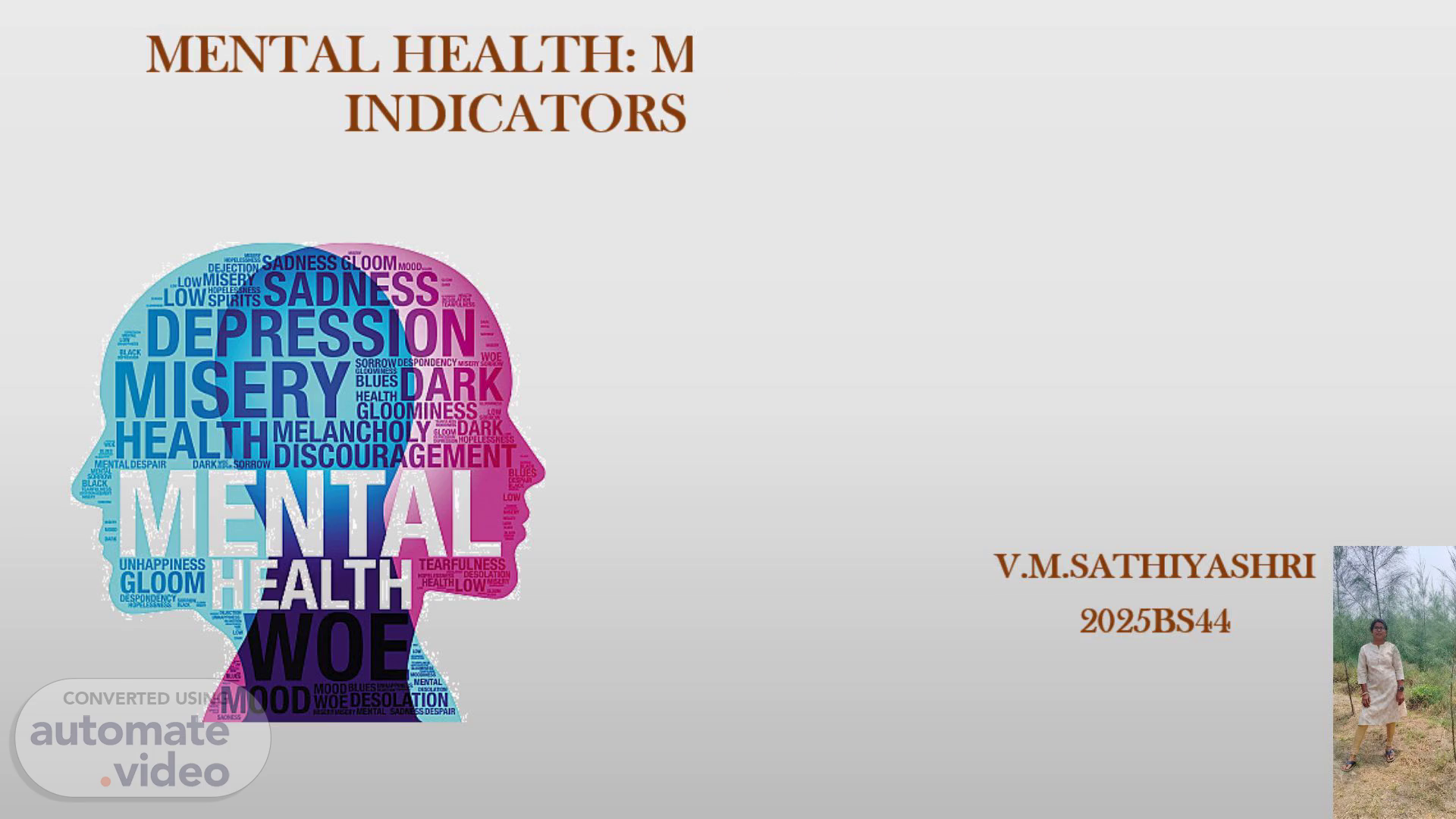
MENTAL HEALTH: MEANING, IMPORTANCE, INDICATORS AND MEASURES
Scene 1 (0s)
MENTAL HEALTH: MEANING, IMPORTANCE, INDICATORS AND MEASURES.
Scene 2 (40s)
[Audio] The original text does not contain any information that needs translation. The text is already written in English. Therefore, no rewriting is required..
Scene 3 (1m 1s)
[Audio] Good mental health has numerous benefits on individuals and the educational environment. Firstly, it enhances concentration, memory, as well as cognitive functioning, resulting in improved academic performance. Secondly, mentally healthy students and teachers can better cope with stress, manage their emotions, and develop positive relationships with each other. This leads to a more supportive and productive learning environment. Furthermore, good mental health enables individuals to possess self-awareness, social skills, emotional intelligence, and effective coping mechanisms to handle academic pressures. These traits allow mentally healthy teachers to provide better guidance and support to their students. Additionally, they can handle emotional outbursts or disruptions more effectively, creating a safer and more respectful classroom environment. Maintaining good relationships with peers, teachers, and family members also contributes to overall well-being. Ultimately, good mental health has a profound impact on the quality of life, enabling individuals to lead healthier, happier lives..
Scene 4 (2m 11s)
[Audio] The indicators of good mental health include positive attitudes toward oneself, growth and development, perception of reality, environmental mastery, autonomy, and integration. Individuals who exhibit these characteristics tend to have better mental health outcomes. A positive attitude toward oneself can indicate confidence and self-esteem, while growth and development can signify personal progress and maturity. Perception of reality can reflect an individual's ability to understand and navigate their surroundings, and environmental mastery can demonstrate control over one's environment. Autonomy and integration also play a role in indicating mental health, as they suggest independence and wholeness. By understanding these indicators, we can gain insight into the complexities of mental health and develop strategies to support individuals in achieving optimal well-being..
Scene 5 (3m 8s)
[Audio] The Kessler Psychological Distress Scale (K10/K6) is a widely used self-report measure for assessing psychological distress and its relationship with other variables. The scale consists of ten items that evaluate psychological distress, including symptoms of anxiety and depression. The scale has been validated through numerous studies and has been shown to be reliable and valid. The GHQ-12 is another commonly used self-report measure that evaluates psychological distress and wellbeing. The GHQ-12 is based on the General Health Questionnaire, which was originally developed by George Brown in 1952. The GHQ-12 has undergone several revisions since its initial development. The scale provides valuable information about an individual's mental health status..
Scene 6 (4m 2s)
[Audio] Mental health encompasses various aspects of well-being, including our thoughts, feelings, and behaviors. It involves being aware of our mental state and taking steps to maintain or improve it. A positive attitude towards oneself, growth, development, and self-actualization are indicators of good mental health. Furthermore, perception of reality, environmental mastery, autonomy, integration, and other factors also contribute to an individual's mental health. Maintaining a healthy balance between different aspects of life is essential for overall well-being. To promote mental health, it is necessary to understand these indicators and measures. This knowledge enables us to take proactive steps towards improving our mental health and reducing misconceptions surrounding it..