Scene 1 (0s)
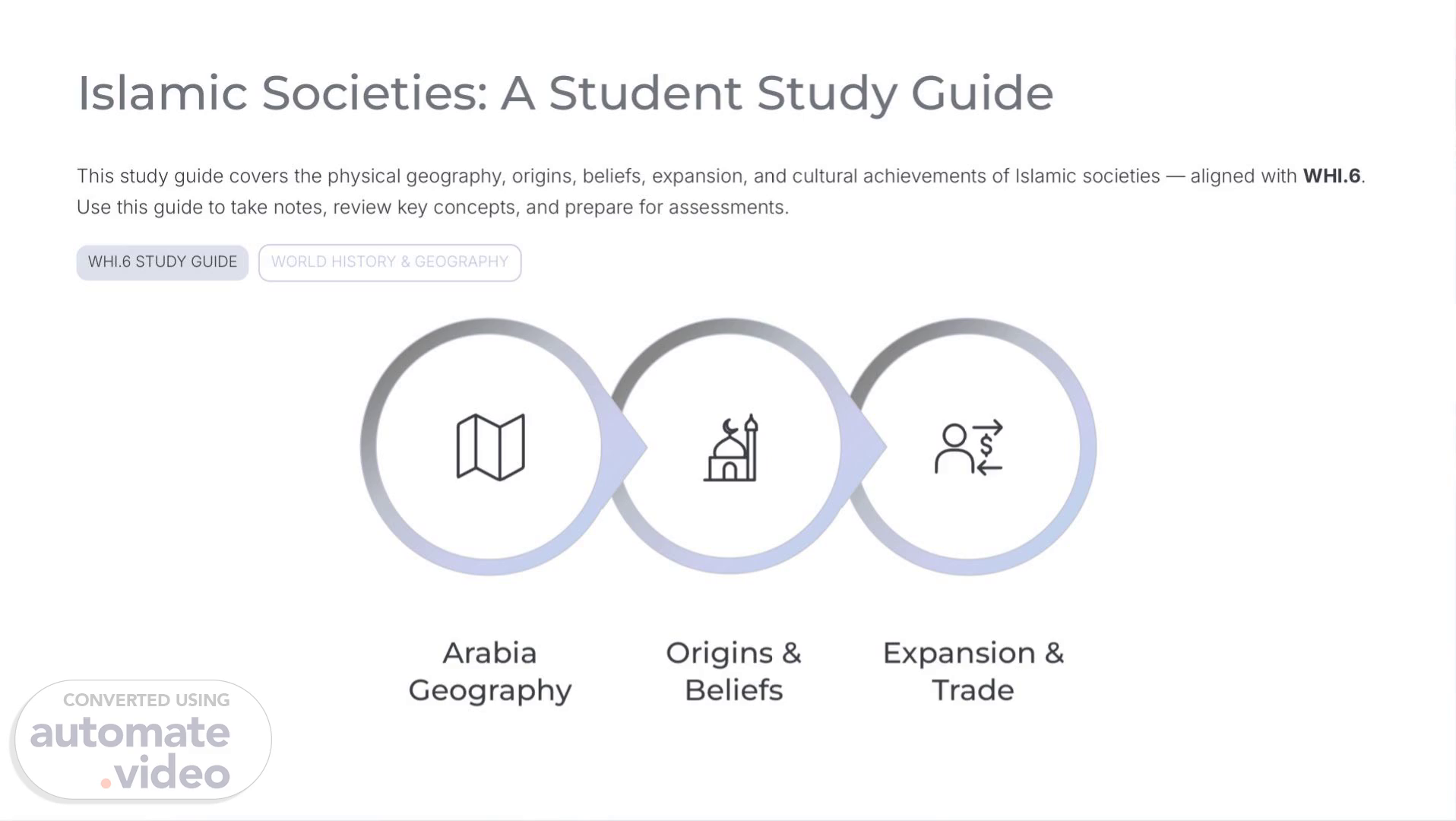
[Audio] Islamic Societies: A Student Study Guide This study guide covers the physical geography, origins, beliefs, expansion, and cultural achievements of Islamic societies 4 aligned with WHI.6. Use this guide to take notes, review key concepts, and prepare for assessments. WHI.6 STUDY GUIDE WORLD HISTORY & GEOGRAPHY Arabia Geography Origins & Beliefs Expansion & Trade.
Scene 2 (31s)
[Audio] CHAPTER 1 The Arabian Peninsula: Physical Geography The Arabian Peninsula is a vast region shaped by desert, sea, and scarce water. Understanding its physical features is essential to understanding how Islamic civilization developed. Arabian Desert Surrounding Seas Oases A massive, harsh desert covering most of the The Arabian Sea, Persian Gulf, and Red Sea Fertile pockets with water and soil that peninsula 4 one of the world's largest and border the peninsula, enabling trade and supported settled farming communities amid most arid regions. cultural exchange. the desert..
Scene 3 (1m 17s)
[Audio] CHAPTER 1 Geography: Key Terms & Map Features Use the list below to identify and label these features on a map of the Arabian Peninsula and surrounding regions. 1 Arabian Peninsula Large landmass in Southwest Asia 4 the birthplace of Islam. 2 Arabian Desert Dominates the interior; extreme heat and aridity shaped nomadic life. 3 Red Sea Western border; key trade and travel route connecting Africa and Arabia. 4 Persian Gulf Eastern border; important for maritime trade with Persia and beyond. 5 Arabian Sea Southern border; connected Arabia to India and East Africa via sea routes. � Map Skill: Also locate the Fertile Crescent, Central Asia, and North Africa on your map 4 these regions interacted closely with the Arabian Peninsula..
Scene 4 (2m 14s)
[Audio] CHAPTER 1 Nomadic vs. Sedentary Ways of Life Both ways of life coexisted on the peninsula. Caravans connected nomadic and sedentary communities, moving products between towns and oases. Many Bedouin ideals 4 such as loyalty to family and survival skills 4 were later absorbed into the Islamic way of life..
Scene 5 (2m 38s)
[Audio] CHAPTER 1 · REVIEW Supporting Questions: Geography Use these questions to guide your notes and review. Write your answers in the space provided during class or study time. What are the key physical features of Arabia? What environmental limitations did people face? How did climate and geography shape cultural development? List the peninsula, desert, and three Think about water scarcity, extreme surrounding bodies of water. Consider how desert conditions led to heat, and limited fertile land. nomadic life and how oases enabled farming. T Skill in Practice: Use maps and map tools to identify and summarize environmental limitations faced by people who lived on the Arabian Peninsula..
Scene 6 (3m 30s)
[Audio] CHAPTER 2 Origins of Islam Key Facts The Hijrah Islam emerged on the Arabian Peninsula Muhammad and his early followers faced persecution in Mecca. This forced them to relocate to Medina 4 a migration known as the Hijrah. This event Founded on the revelations of the Prophet Muhammad marks a major turning point in Islamic history and the beginning of the Islamic A monotheistic faith 4 worship of one God, Allah calendar. Accepts earlier prophets including Moses and Jesus Grew from a regional faith into a global religion � Note: The Hijrah is considered one of the most significant events in the founding of Islam..
Scene 7 (4m 14s)
[Audio] CHAPTER 2 People & Places: Early Islam Muhammad Mecca The Prophet of Islam. His revelations form the basis of the Islamic Birthplace of Muhammad and original center of early Islam. Home religion. His teachings are recorded in the Qur'an. of the Kaaba, a sacred site central to Islamic worship. Medina The Kaaba City to which Muhammad and followers migrated during the Hijrah. Sacred structure in Mecca. Significant in the development of Islam Became the first Islamic community and political center. as a central place of pilgrimage and worship..
Scene 8 (4m 54s)
[Audio] CHAPTER 2 Core Beliefs of Islam The basic tenets of Islam center on monotheism and a set of required practices known as the Five Pillars. These pillars are the foundation of Muslim practice and daily life, uniting Muslims across cultures and regions..
Scene 9 (5m 15s)
[Audio] CHAPTER 2 The Qur'an and the Sunnah The Qur'an The Sunnah The holy book of Islam, containing the recorded revelations of The traditions and practices of the Prophet Muhammad. It serves as Muhammad. It is the primary source of Islamic belief, practice, and a model for Muslims to follow in their daily lives 4 covering everything law. Muslims regard it as the direct word of Allah. from prayer to social conduct. Written in Arabic Recorded in the Hadith Guides worship, ethics, and law Complements the Qur'an Central to Islamic education Shapes Islamic law (Sharia) ' Key Idea: Together, the Qur'an and Sunnah are the two primary sources of Islamic belief, practice, and law..
Scene 10 (6m 2s)
[Audio] CHAPTER 2 · REVIEW Supporting Questions: Origins & Beliefs 01 02 What are the origins of Islam? How is Islam connected to Judaism and Christianity? Where and how did Islam begin? Who founded it and what were the All three are monotheistic. Islam accepts Moses and Jesus as earlier early challenges? prophets. 03 04 What are the major beliefs, customs, and traditions? In what ways were Muhammad and his followers persecuted? Focus on monotheism, the Five Pillars, the Qur'an, and the Sunnah. Describe events in Mecca and the significance of the Hijrah to Medina..
Scene 11 (6m 48s)
[Audio] CHAPTER 3 The Expansion of Islamic Territory Despite geographic barriers, Islamic societies expanded rapidly after the death of Muhammad. Expansion was also facilitated by weakened political empires in the region. Arabia North Africa Origins in 7th century Coastal expansion to Spain Middle East Central Asia Conquest and Persian lands Into Central Asia and India Political unity and the Arabic language were key tools that facilitated trade, governance, and intellectual activity across vast territories. ¦ Key Turning Point: The split of Islam into Sunni and Shi'a branches occurred during the Umayyad Caliphate 4 a major historical turning point..
Scene 12 (7m 38s)
[Audio] CHAPTER 3 Key People & Places: Islamic Empires Umayyad Caliphate Abbasid Dynasty First major Islamic dynasty after the early caliphs. Expanded Succeeded the Umayyads. Known for centralized government, territory greatly but saw the Sunni-Shi'a split emerge during this the establishment of a judicial system, and making Baghdad the period. capital of a flourishing civilization. Baghdad Battle of Tours (732 CE) Capital of the Abbasid Caliphate. A major center of trade, Halted Islamic expansion into Western Europe. Marked a scholarship, and culture 4 home to universities and libraries significant boundary in relations between Islamic societies and during the Islamic Golden Age. Christian Europe..
Scene 13 (8m 36s)
[Audio] CHAPTER 3 Sunni vs. Shi'a: The Great Split This division arose during the Umayyad Caliphate over the question of rightful leadership after Muhammad's death. It remains one of the most significant divisions in Islam today and had lasting global influences on Islamic politics and culture..
Scene 14 (8m 55s)
[Audio] CHAPTER 3 Islamic Trade Routes The Muslim world interacted with the rest of the world through extensive land and sea trade routes. These networks spread goods, ideas, and culture across continents. Sea Routes The Silk Road Letters of Credit The Mediterranean Sea and Indian Ocean Major overland route linking the Islamic world Banks established throughout the Muslim connected Muslim merchants to Europe, East to China and Central Asia, facilitating the world offered letters of credit to merchants, Africa, India, and Southeast Asia. exchange of goods and knowledge. encouraging the flow of trade without carrying physical currency..
Scene 15 (9m 37s)
[Audio] CHAPTER 3 Products & Inventions Along Trade Routes Goods and innovations traveled along Islamic trade routes, connecting Asia, Africa, and Europe. These exchanges transformed economies and daily life across the known world. Spices Textiles Paper Highly valued for food preservation and Fine fabrics including silk and cotton Adopted from China; spread literacy and flavor; traded from South and Southeast moved along routes from China and scholarship throughout the Islamic world Asia. India. and into Europe. Steel New Crops Advanced metalworking techniques spread through trade, Agricultural innovations including new crop varieties spread improving tools and weapons. across regions, improving food security..
Scene 16 (10m 26s)
[Audio] CHAPTER 3 Islamic Cultural & Scientific Achievements Islamic societies made remarkable achievements during the Golden Age that continue to influence the modern world. Algebra & Mathematics Muslim scholars developed algebra and popularized Arabic numerals (the number system used worldwide today). Medicine Advances in medical knowledge, including encyclopedic medical texts, shaped European medicine for centuries. Architecture Iconic structures like the Dome of the Rock in Jerusalem showcase the sophistication of Islamic art and architecture. Universities & Translation Baghdad's universities preserved and translated ancient Greek and Roman texts into Arabic, saving classical knowledge. Geographic Knowledge Muslim geographers expanded global knowledge of the world's lands, seas, and peoples..
Scene 17 (11m 20s)
[Audio] CHAPTER 3 · REVIEW Supporting Questions: Expansion & Trade How did geography impact the growth of Islamic empires? Consider both barriers (deserts, mountains) and advantages (sea routes, oases). What factors contributed to rapid expansion? Think about political unity, the Arabic language, and weakened neighboring empires. What led to division within the Islamic empires? Describe the Sunni-Shi'a split and its causes during the Umayyad Caliphate. How did merchants impact Islamic society? Consider the role of trade routes, banks, letters of credit, and city growth. What were the cultural achievements of Islamic society? List contributions in math, medicine, architecture, and scholarship..
Scene 18 (12m 11s)
[Audio] VOCABULARY REVIEW Key Terms Glossary Term Definition Bedouin Nomadic Arab herders who inhabited the desert regions of Arabia; their ideals of loyalty and survival influenced Islamic culture. Oasis A fertile area in a desert with water and vegetation; supported sedentary farming communities. Hijrah The migration of Muhammad and his followers from Mecca to Medina; marks the start of the Islamic calendar. Monotheism Belief in one God; a core tenet of Islam, Judaism, and Christianity. Qur'an The holy book of Islam containing Muhammad's revelations; primary source of Islamic belief and law. Sunnah The traditions and practices of Muhammad; a model for Muslim daily life. Caliphate The political-religious state led by a caliph (successor to Muhammad) governing the Muslim community. Sunni / Shi'a The two major branches of Islam, divided over rightful leadership after Muhammad's death..
Scene 19 (13m 17s)
[Audio] TIMELINE Timeline of Islamic History Use this timeline to track the major events and turning points in the development and spread of Islamic societies. 1 ~570 CE Birth of Muhammad in Mecca 2 610 CE Muhammad receives first revelations; Islam begins 3 622 CE The Hijrah 4 migration from Mecca to Medina 4 632 CE Death of Muhammad; early caliphates begin 5 661 CE Umayyad Caliphate begins; Sunni-Shi'a split emerges 6 732 CE Battle of Tours halts Islamic expansion into Western Europe 7 750 CE Abbasid Dynasty rises; Baghdad becomes capital of Islamic Golden Age.
Scene 20 (14m 8s)
[Audio] STUDY CHECKLIST Review & Study Checklist Use this checklist to confirm you have mastered the key skills and concepts from WHI.6 before your assessment. Geography & Ways of Life Expansion & Trade Identify physical features of the Arabian Peninsula on a map Trace the expansion of Islamic territory on a map Explain how climate shaped nomadic and sedentary life Explain the Sunni-Shi'a split and its causes Describe the role of oases and caravans Describe the role of the Abbasid Dynasty and Baghdad Compare Bedouin and settled farming communities Identify products traded along Islamic trade routes Explain how letters of credit encouraged trade Origins & Beliefs Cultural Achievements Describe the origins of Islam and the role of Muhammad Explain the Five Pillars of Islam List Islamic contributions to math, medicine, and architecture Distinguish between the Qur'an and the Sunnah Explain the significance of universities and translation work Explain the significance of the Hijrah and the Kaaba Create a timeline of major Islamic historical events � You're ready! Review your notes, complete the supporting questions, and use the glossary to master all key terms..