Scene 1 (0s)
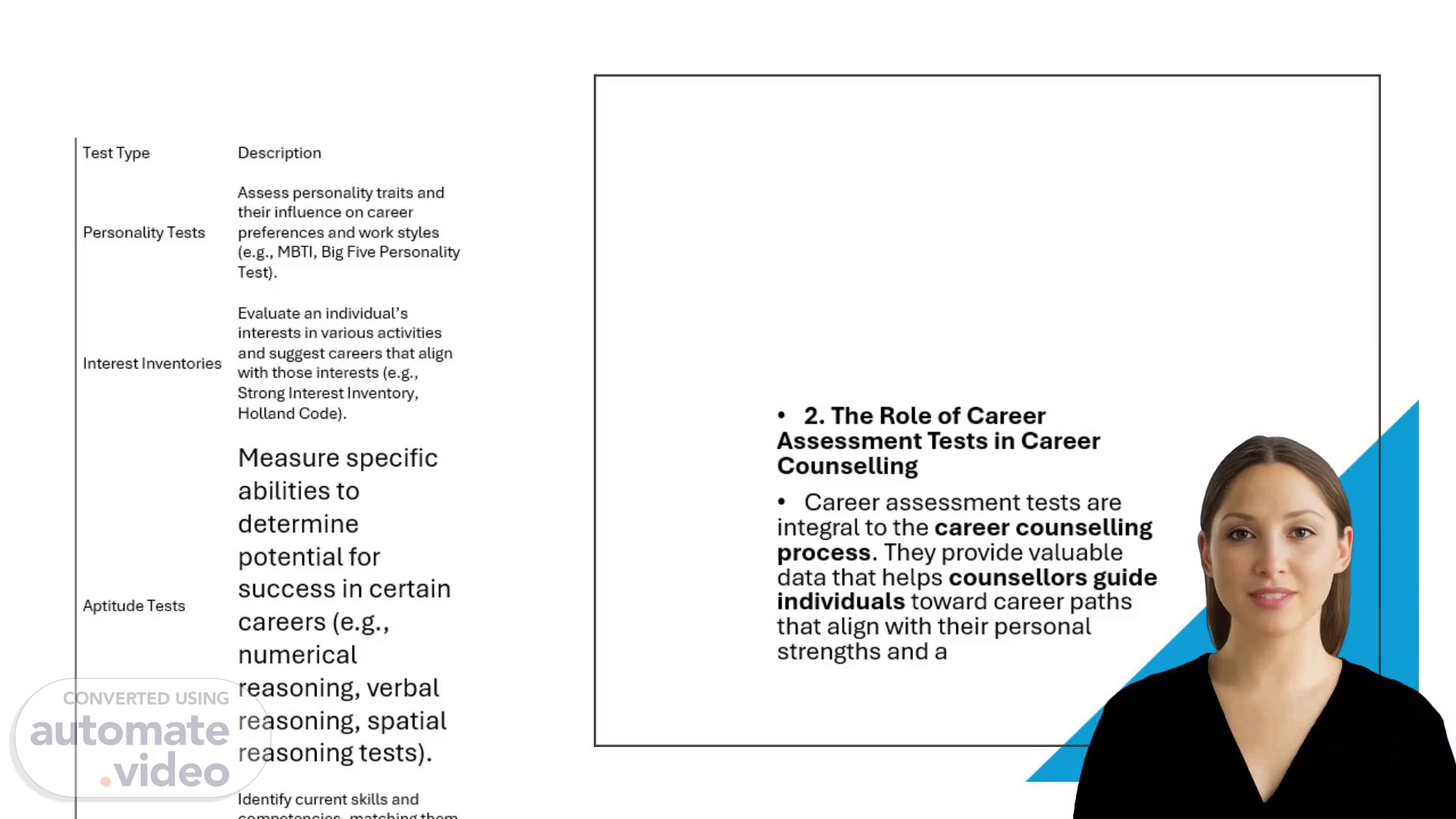
[Virtual Presenter] "Personality tests are used to predict a person's behavior and performance at work. They can be categorized into two main types: behavioral and biographical. Behavioral personality tests focus on past behaviors and attitudes, while biographical personality tests examine an individual's life history and experiences. Both types of tests aim to provide insights into a person's personality structure and its impact on their career choices and work style.".
Scene 2 (32s)
[Audio] The career assessment tests are designed to measure the cognitive abilities of individuals. The tests assess various aspects of cognition such as memory, problem-solving, and decision-making. The results of these tests can be used to identify areas where an individual may need improvement, allowing them to develop strategies for personal growth and development. The tests also evaluate an individual's emotional intelligence, social skills, and communication abilities. These evaluations can help individuals understand their strengths and weaknesses, enabling them to make informed decisions about their careers. Furthermore, the tests can provide insights into an individual's values, motivations, and goals, which can guide their career choices. The assessments can also reveal potential career paths that may not have been considered by the individual prior to taking the test..
Scene 3 (1m 30s)
[Audio] The use of personality tests has been criticized for its lack of scientific basis and reliability. Critics argue that many personality tests rely heavily on self-reporting, which can lead to biased results. Furthermore, some critics point out that personality tests often fail to account for cultural differences and individual variations within cultures. This criticism highlights the need for more nuanced and culturally sensitive assessments..
Scene 4 (1m 59s)
[Audio] The Strong Interest Inventory is a widely used tool to assess an individual's interests in various activities. The inventory helps individuals identify their preferred activities and hobbies. This information can be used to suggest potential career paths that align with an individual's interests. The inventory consists of a series of questions that ask about an individual's preferences regarding different types of activities. The results of the assessment can provide valuable insights into an individual's strengths and weaknesses. The Holland Occupational Themes are another popular tool used to explore an individual's interests. The themes are based on six occupational categories: Realistic, Investigative, Artistic, Social, Enterprising, and Conventional. Each category represents a set of skills and knowledge that are valued in different careers. By using the Holland Occupational Themes, individuals can gain a better understanding of their own interests and values. This information can be used to make informed decisions about future career choices. Interest inventories like the Strong Interest Inventory and the Holland Occupational Themes offer several benefits. They provide a framework for exploring an individual's interests and values. They also offer guidance on potential career paths that align with an individual's interests. Furthermore, these assessments can help individuals identify their strengths and weaknesses, which can inform their career decisions. Additionally, interest inventories can help individuals develop a sense of purpose and direction in their lives..
Scene 5 (3m 43s)
[Audio] The aptitude test is designed to evaluate an individual's ability to perform tasks that require critical thinking, problem-solving, and analytical skills. The test assesses various aspects of cognitive function, including memory, attention, and processing speed. The results of the test can be used to identify areas where an individual needs improvement, allowing them to develop strategies for enhancing their performance..
Scene 6 (4m 11s)
[Audio] Skills assessments are a crucial tool in the career development process. Individuals who undergo these assessments can identify their current skills and competencies, which enables them to make informed decisions about their future career prospects. Furthermore, skills assessments help individuals to recognize their strengths and weaknesses, allowing them to focus on building their skills and addressing any gaps in their knowledge or experience. By doing so, they can increase their chances of success in their chosen field. Skills assessments also provide valuable insights into an individual's potential for growth and development, enabling them to set realistic goals and objectives. In addition, skills assessments can be used as a basis for performance evaluations and salary negotiations. Overall, skills assessments play a vital role in helping individuals achieve their career goals..