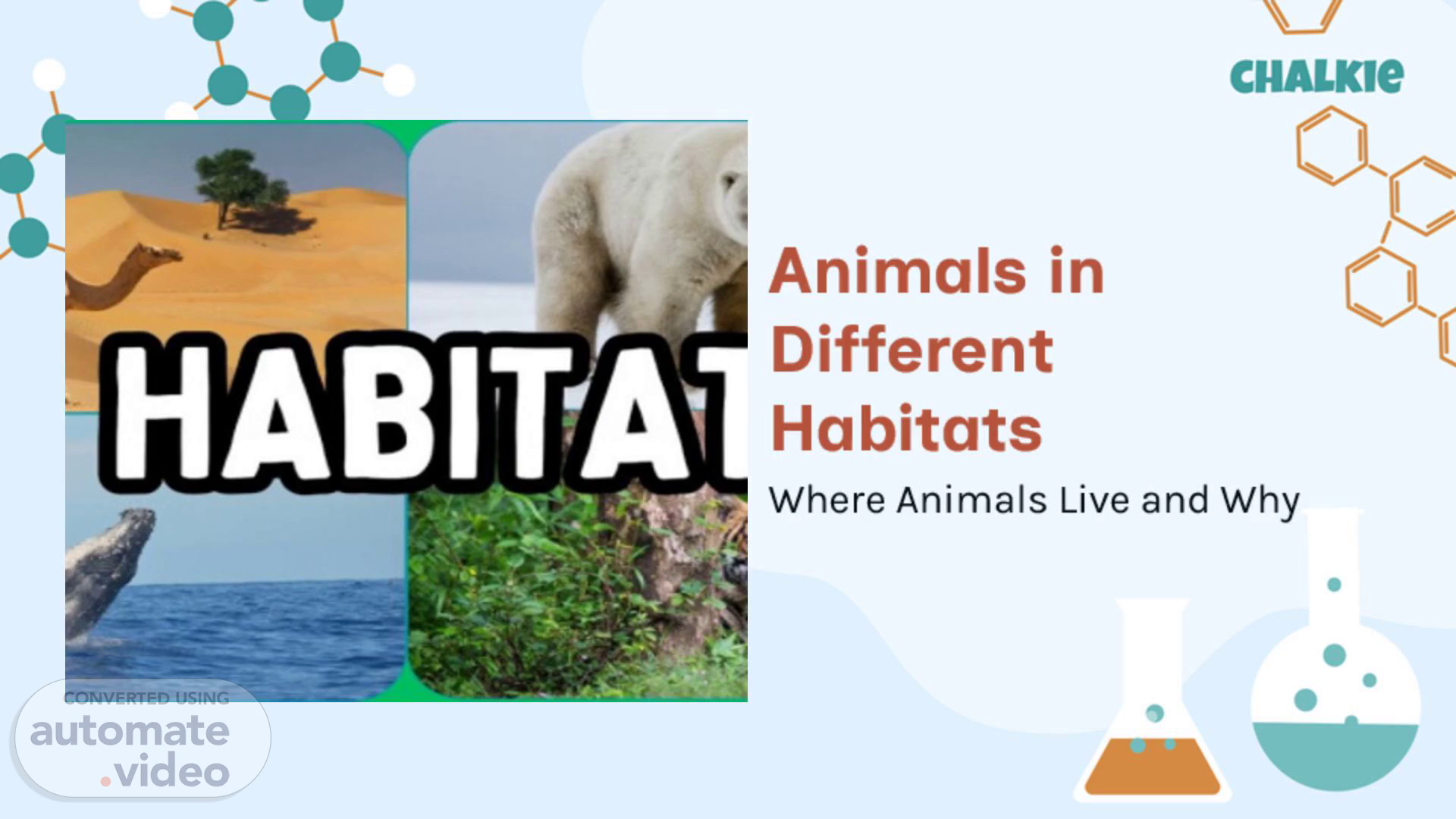
Scene 1 (0s)
[Audio] We are excited to share with you the amazing world of animals and the different habitats they call home. Our meeting today focuses on the theme "Animals in Different Habitats." This presentation explores the various habitats that animals live in and the reasons behind their choice of habitat. It is divided into four main sections, each focusing on a different type of habitat. These sections cover forests, water, snow, and deserts, and the animals that live in each of these habitats. Our goal is to educate and engage our audience, while promoting an appreciation for the natural world. Our presentation begins with the title slide, which sets the scene for our journey into the world of animals and habitats. The title slide reads: "Animals in Different Habitats Where Animals Live and Why." This is the introductory slide, which introduces the topic of Animals in Different Habitats Where Animals Live and Why. The first section of our presentation covers the forest habitat. In this section, we will explore the types of trees, plants, and other organisms that live in the forest ecosystem. We will also examine the role of animals such as bears, deer, and squirrels in the forest ecosystem. Next, we will move on to the water habitat. In this section, we will explore the different types of aquatic life, including fish, dolphins, and whales. We will also examine the role of animals such as otters, beavers, and birds in the water habitat. After that, we will cover the snow habitat. In this section, we will explore the unique adaptations of animals such as penguins, arctic foxes, and polar bears in the snow environment. We will also examine the role of animals such as seals, walruses, and snowy owls in the snow habitat. Finally, we will conclude with the desert habitat. In this section, we will explore the unique adaptations of animals such as camels, lizards, and snakes in the desert environment. We will also examine the role of animals such as coyotes, jackrabbits, and roadrunners in the desert habitat. Throughout our presentation, we will use visual aids and examples to illustrate the different habitats and the animals that live in them. Our goal is to educate and engage our audience, while promoting an appreciation for the natural world..
Scene 2 (2m 32s)
[Audio] The animal's habitat is where it lives and grows. The habitat provides all the necessities for survival. These include food, water, shelter, space to live and play. Every animal has its own unique home. Just like humans, animals need a place to rest and feel safe. Animals live in various environments such as forests, deserts, oceans and more. Each environment has its own set of rules and conditions that must be met by the animals living there. The environment influences the behavior and habits of animals. To keep the planet healthy, understanding what makes a good habitat is vital. Learning about different habitats and the creatures that inhabit them helps us appreciate the diversity of life on Earth..
Scene 3 (3m 23s)
[Audio] The forest habitat is characterized by its dense canopy and varied vegetation. The trees in this habitat provide shade, protection from harsh weather conditions, and food sources for many animals. The understory layer is home to smaller plants and shrubs, which offer additional shelter and food for animals. The forest floor is often covered with leaf litter, moss, and other organic matter, creating a humid environment that supports a wide range of plant and animal life..
Scene 4 (3m 55s)
[image]. [image].
Scene 5 (4m 1s)
[image]. [image] -maturi. [image]. [image].
Scene 7 (4m 14s)
The Water Habitat. Warm and Cool Climates Water can have wet and cold climates..
Scene 8 (4m 22s)
144 Octopus Beautiful Underwater Scenery Stock Photos - Free & Royalty-Free Stock Photos from Dreamstime.
Scene 10 (4m 36s)
Quick Habitat Quiz. Which animal would be best suited for a forest habitat?.
Scene 11 (4m 50s)
Quick Habitat Quiz. Which animal would be best suited for a forest habitat?.
Scene 12 (4m 58s)
[image]. The Snow Habitat. Freezing and Icy Snow can have cold climates. Snow Animals Animals need special ways to keep warm. Polar bears have thick fur and blubber (fat). Penguins huddle together in groups to share heat..
Scene 13 (5m 12s)
The Emperor Penguins of Antarctica's Snow Hill Island - Scenic.
Scene 15 (5m 25s)
[Audio] The character of "Don't know" is a common one in many cultures, often used as a polite way to express uncertainty about something. In some cultures, it's considered impolite to say "I don't know", while in others it's seen as a sign of humility and respect for knowledge. The term has been used in various contexts such as education, business, and everyday conversation. In Japan, the phrase "" (genjitsu) means "to be uncertain" or "to be unclear". This phrase is often used by Japanese people when they are unsure about something. In other cultures, similar phrases like "I'm not sure" or "I'm not familiar with that" are commonly used. The term "Don't know" can also be used in a more humorous or ironic way, implying that someone is intentionally avoiding answering a question. This usage is often seen in Western cultures, particularly in the United States. In some cases, saying "Don't know" may be seen as a sign of weakness or lack of confidence. However, in many cultures, it's viewed as a positive trait to admit uncertainty and seek clarification..
Scene 16 (6m 32s)
Desert Snake Stock Photos, Images and Backgrounds for Free Download.
Scene 17 (6m 43s)
Scorpion Desert Images – Browse 20,210 Stock Photos, Vectors, and Video | Adobe Stock.
Scene 18 (6m 52s)
[image]. [image]. [image]. [image]. Match the words with the pictures 🎯.
Scene 19 (7m 6s)
[image]. [image]. [image]. [image]. Match the words with the pictures 🎯.
Scene 20 (7m 20s)
[image]. Wonderful World of Habitats We Learned: Forests are full of trees and climbing animals. Water habitats are home to swimmers. Snow habitats are for animals with thick fur. Deserts are hot, dry places. Every animal is perfectly suited to its home!.
Scene 21 (7m 35s)
[image]. [image]. Get creative 🖼️. Design a new animal for a habitat. Draw it and label its home, safety features, and diet. What you'll need: 🎨 🖌️ Paper, pencils, coloured pens.